


A very good Day to you all!
During the time of advent, we as church would like to remember the birth of Jesus Christ and the implications of it for mankind.
We find two records of the birth of Jesus in the gospels and specifically in Matthew and Luke. It is most interesting to note that two records have different materials selected and they complement each another.
We know that Matthew is writing to a Jewish audience, whom he wants to show that Jesus is the Messiah, who was promised all through the Scriptures, that we call today the Old Testament. Matthew tells us the birth narrative from the perspective of the genealogy line of Joseph. Joseph was the adopted father of Jesus and that shows the legal royal status of Jesus. A king is born from a Jewish kingly family. It starts with Abraham the father of the people of Israel through David, the great king, who is in some sense a type of the Messiah! Matthew also takes for granted that his readers, being Jews, would understand the idioms of speech of the Jews and would be acquainted with their customs.
Luke, on the other hand, is writing to Theophilus, an honored Roman official who was probably located in Rome, who was Greek-speaking, and knew very little about the Jews and their ways. Thus, the gospel of Luke is written for a gentile audience and often clarifies the history a bit more.
We find it interesting that Luke’s nativity story is told more from the side of Mary and the biological lineage of Jesus. Both Joseph and Mary were from the line of David in the tribe of Judah! Luke starts with Jesus and goes all the way back to Adam. Why? Is it because Adam is the ancestor to the whole human race, the whole world, and not only the Jews? Remember Luke writes to share the gospel with people from other nations, called gentiles or heathens.
Why is Matthew’s then reporting of the wise men of the East and not rather Luke? Matthew writes to Jews and would like to share the gospel with Jews. Why is it that Matthew tells his readers about the wise men coming from the East, who were not Jews, but gentiles? That is an interesting question to ask, don’t you think? And why would these gentiles come to visit a king born to the Jews?
To answer these questions, we would like to speak today about: “The Wise Men from the East – Who were they, and what message may we take from their visit?”
Let us now read our Scripture in Matthew 2:1-12 –
2 Now after Jesus was born in Bethlehem of Judea in the days of Herod the king, behold, wise men from the East came to Jerusalem, 2 saying, “Where is He who has been born King of the Jews? For we have seen His star in the East and have come to worship Him.”
3 When Herod the king heard this, he was troubled, and all Jerusalem with him. 4 And when he had gathered all the chief priests and scribes of the people together, he inquired of them where the Christ was to be born.
5 So they said to him, “In Bethlehem of Judea, for thus it is written by the prophet:
6 ‘But you, Bethlehem, in the land of Judah, are not the least among the rulers of Judah; for out of you shall come a Ruler who will shepherd My people Israel.’ ”
7 Then Herod, when he had secretly called the wise men, determined from them what time the star appeared. 8 And he sent them to Bethlehem and said, “Go and search carefully for the young Child, and when you have found Him, bring back word to me, that I may come and worship Him also.”
9 When they heard the king, they departed; and behold, the star which they had seen in the East went before them, till it came and stood over where the young Child was. 10 When they saw the star, they rejoiced with exceedingly great joy. 11 And when they had come into the house, they saw the young Child with Mary His mother, and fell down and worshiped Him. And when they had opened their treasures, they presented gifts to Him: gold, frankincense, and myrrh.
12 Then, being divinely warned in a dream that they should not return to Herod, they departed for their own country another way.
Let us see if we may determine who the wise men or magi were.
Who were the Magi? (What is their identity?)
 The text reads: “After Jesus was born in Bethlehem … behold, wise men from the East came to Jerusalem”
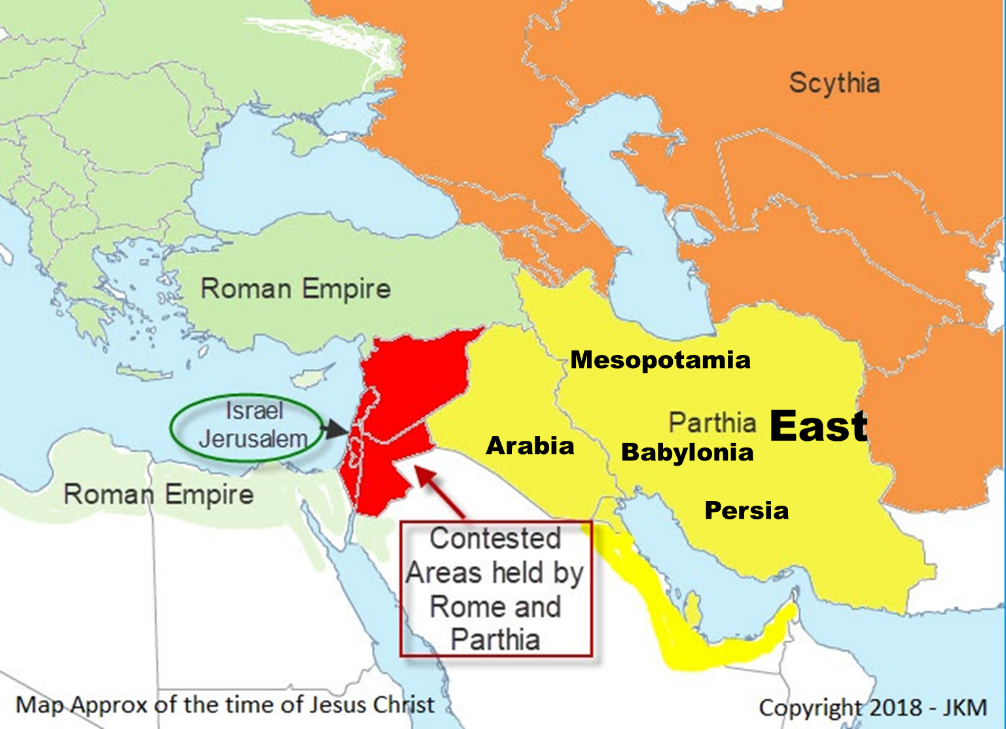
Let’s look at a map of the East at the time of Jesus. (Map of Parthia)
The green at the left is the Roman Empire under whose rule Israel was at that time. The red zone was Israel and adjacent areas like Syria, which formed sort of a buffer between the Roman Empire in the West and the Opposing Parthian Empire in the East. The East has regions like Parthia, Media, Persia, Babylonia, Mesopotamia, and the Arabic Peninsula. Don’t confuse Mesopotamia with Macedonia. Mesopotamia is in the East (it means “between rivers” and refers to land between the Tigris and Euphrates rivers. Macedonia is Greece in the West.
It immediately should strike us that the East concerns the people of Israel in their history. Abraham was called from the ancient Ur of the Chaldeans, which is Babylonia territory, and it might even be that the wise men also came from there. Besides that, we know that the Northern ten tribes of Israel were taken into exile by the Assyrians, which were a Mesopotamian kingdom. This happened about 721 BC. About a hundred years later the two tribes in the South called Judah were taken into exile by Babylon.
We may wonder what influence the Israelites would have on these nations. We would find information about this in the Bible or example in the Book of Daniel. And then also from secular historians.
The wise men or magi were known as the priestly-political class of the Parthians. In history, we may be told that there were magi in the seventh century BC as a tribe in Eastern Mesopotamia among the Medes and the Persians. The wise men were scientists in an era where science was also investigating things about God. The Magi were sincere individuals trying to figure things out. They were sincere people and very serious. You don’t travel for just over a thousand kilometers through deserts and with animals if you are not very serious.
They had a good general knowledge of science, agriculture, mathematics, history, astronomy, astrology, and the occult. They had a growing religious and political influence and therefore became a prominent and powerful group of advisors to kings in the Babylonian and the following Medo-Persian empires. They were also acknowledged for their ability to interpret dreams.
Maybe it would be a challenge to learn that they might have been involved in astrology and sorcery. Why are they portrayed as coming to look for the Messiah and bring honor to Him as they seem to practice things that the Scriptures forbid? Of course, the fact that they are included in visiting Jesus, and recognizing Him as the Messiah king, doesn’t sanction any of the wrong practices that they might have been involved in.
That encourages us even more to try to determine why Matthew mentions their visit to his Jewish audience. Let us see if we may read more about them in the Bible. We read in the book of Daniel that some young Jewish men of Jerusalem, Daniel and his friends were fine men among the first group that went into exile in Babylon about 605 BC.
We read in Daniel 1:3-4 that King Nebuchadnezzar was looking for some of the children of Israel who were young men in whom there was no blemish, good-looking, gifted in all wisdom, possessing knowledge and quick to understand, who had ability to serve in the king’s palace, and whom they might teach the language and literature of the Chaldeans.
Daniel 1:3-4: 3 Then the king instructed Ashpenaz, … to bring some of the children of Israel … 4 young men in whom there was no blemish, but good-looking, gifted in all wisdom, possessing knowledge and quick to understand, who had ability to serve in the king’s palace, and whom they might teach the language and literature of the Chaldeans.
We read later on, in Daniel 1:17: –
Daniel 1:17: 17 As for these four young men, God gave them knowledge and skill in all literature and wisdom; and Daniel had understanding in all visions and dreams.
Here was an opportunity that God Himself opened up. Some of the bright young men of Israel were chosen to become wise men in the East and be part of the king’s advisors in the time of the Babylonian empire. Daniel and his friends were Godly men and their involvement in this sphere was ordained by God and must have left an impact on the wise men or magi of the East forever after.
We read even more about these kingly advisors, the wise men of whom God appointed Daniel, a Godly man as their leader in Daniel 2.
Daniel 2:1-3:1 Now in the second year of Nebuchadnezzar’s reign, Nebuchadnezzar had dreams; … 2 Then the king gave the command to call the magicians, the astrologers, the sorcerers, and the Chaldeans to tell the king his dreams. So, they came and stood before the king. 3 And the king said to them, “I have had a dream, and my spirit is anxious to know the dream.”
Can you start to imagine how the thinking of these magi must have been shaped by Daniel and other Godly Jews in exile? We read later how even King Nebuchadnezzar was moved towards God.
Still later, when the Babylonian empire fell to the Medes and Persians, the involvement of these wise men in making and advising kings continued. We read in Daniel 6 in the time of the Persian Empire’s king Darius the following:
Daniel 6:8-9: 8 Now, O king, establish the decree and sign the writing, so that it cannot be changed, according to the law of the Medes and Persians, which does not alter.” 9 Therefore King Darius signed the written decree.
We have already mentioned that God’s people of old, the people of Israel, were scattered among the nations. It is reckoned that “the law of the Medes and Persians” was founded on the teachings of these magi. From history, we see that for a Persian to become king he must master the scientific and religious disciplines of the magi and only then could be approved and crowned by them. That is what is meant by “the law of the Medes and Persians”. It is the law of the magi or wise men. Therefore, the wise men may be called “king makers”. How interesting that God would use earthly king makers from the gentile nations to crown the heavenly King here on earth?
In Jeremiah 39 we read something interesting. We must remember that Jeremiah was a prophet in Judah before, during, and after its fall to Babylon in 586 B.C. We read in Jeremiah that when Jerusalem was besieged by Nebuchadnezzar, some of his princes were there. We read about a person called Nergalsarezer. He is referred to as the Rabmag. Some suggest that “Rabmag” is the “chief of the Babylonian magi” or “chief of the priests”. Here it is mentioned that this wise man was with Nebuchadnezzar when he attacked and conquered Judah.
Jer 39:1-3: 1 In the ninth year of Zedekiah king of Judah, in the tenth month, Nebuchadnezzar king of Babylon and all his army came against Jerusalem, and besieged it. … 3 Then all the heads (princes) of the king of Babylon came in and sat in the Middle Gate: Nergal-Sharezer, Samgar-Nebo, Sarsechim, Rabsaris (chief of the eunuchs), Nergal-Sharezer, Rabmag (chief of the Mages), and all the rest of the heads (princes) of the king of Babylon.
Thus, we learn from the book of Daniel that the magi, or wise men, were among the highest-ranking officials in Babylon. They were thus very important and noble men. They were involved in the crowning of kings. Our Matthew text tells us that they were involved in what we may describe as the earthly crowning of the King of kings. How amazingly is our God involved in the unfolding of history?
We have identified the wise men somewhat. Now we need to determine:
How did it come that the wise men were expecting the birth of a king for the world at this time? (Enquiry)
Their inquiry to the people of Jerusalem: “Where is he who has been born King of the Jews?” These wise men had come to the conviction that a significant King had been born that this King was directly related to the Jewish people and that this King had been born in Judea
We see that Israel was scattered through the nations with the exiles of the Northern 10 tribes to Assyria and the Southern 2 tribes to Babylon. With this scattering, one may deduce that the Messianic expectations that the Jews had were also scattered among the nations.
How could the time of the arrival of the king be known?
Let’s look at Scripture and we read in the setting wherein Jacob (Israel) was blessing his sons. In Gen 49:10 we read his prophecy about Judah:
Gen 49:10: 10 The scepter will not depart from Judah, nor the ruler’s staff from between his feet, until He comes to whom it belongs, and the obedience of the nations is His.
A scepter portrays the rule of a king. Thus, the prophesy is saying that there will always be a ruler on the throne of the tribe of Judah, that is the line through David until the Messiah comes to whom this throne actually belongs.
If we follow the Biblical record, we may see the Southern kingdom was always governed by a king of the tribe of Judah. Thus, the scepter did not depart from Judah until about 40 years before the birth of Christ. This was when the Romans who had conquered the world and established the Roman Empire, installed a king for the Jews who was an Edomite. King Herod the Great.
When Herod the Great became the ruler about 40 years before Christ’s birth, some of the Jewish rabbis noted that it seemed that the scepter did indeed now depart from Judah. This was a huge alarm and it signaled that the time of the coming of the Messiah should be at hand. There was an expectation that the Messiah king would be born within that generation. Interestingly in Jewish thinking, the length of a generation is seen as 40 years, and this expectation was indeed fulfilled.
A second prophecy that may have caused the Jews and therefore the Gentiles around them, who knew of their expectation, to think that the Messiah would come at this particular time is a prophecy given in Daniel 9:24-27, the prophecy of the 70 year-weeks.
Daniel 9:25: – “Know therefore and understand, that from the going forth of the command to restore and build Jerusalem until Messiah the Prince, there shall be seven weeks and sixty-two weeks.
The term “weeks” in this prophecy means sevens and is regarded as a period of 7 years, also called year-weeks. Thus 69 sevens (year-weeks) is 483 years. In total 490 years are in view here.
Beginning with the decree of King Cyrus of Persia, there were 3 decrees, and it brings one despite uncertainties approximately at the time when Jesus came. Remember the writings of Daniel were available to the wise men, as Daniel was the head of the wise men for a lengthy period of time. Being scientists, they would be able to carefully calculate the time of the coming of the Messiah from this prophecy alone. Actually, the Scribes, Priests, and Pharisees in Jerusalem also were supposed to determine this, but they were occupied with themselves and were indifferent to the Messiah’s coming. What a contrary are these sincere, seeking gentile wise men, who were following the little light from Scriptures they had.
On another occasion, Daniel saved the lives of the wise men, when he interpreted a dream of King Nebuchadnezzar, with God’s help. Here it is also mentioned that there is a new superior kingdom to come
Daniel 2:27-28: – 27 Daniel answered in the presence of the king, and said, “The secret which the king has demanded, the wise men, the astrologers, the magicians, and the soothsayers cannot declare to the king. 28 But there is a God in heaven who reveals secrets, and He has made known to King Nebuchadnezzar what will be in the latter days.
Daniel 2:44: 44 And in the days of these kings the God of heaven will set up a kingdom which shall never be destroyed; and the kingdom shall not be left to other people; it shall break in pieces and consume all these kingdoms, and it shall stand forever.
This must have made an impact on the wise men. Daniel became their leader and he testified about God and his prophesies. The God of heaven will set up a kingdom that shall never be destroyed. Daniel was always looking forward to a day when the Saints of the Most High would receive and possess a kingdom that will be forever and ever. That kingdom also had a king that was to come.
Daniel 5:11: And King Nebuchadnezzar your father – your father the king – made him (Daniel) chief of the magicians, astrologers, Chaldeans, and soothsayers.
Besides getting direct insights from God, Daniel also had Scripture where he must have read the prophecy of Balaam in Numbers 24:16 & 17 about 800 years before Christ. Balaam may also have been an astrologer, a precursor to the wise men. God showed him, a gentile, things to come.
Numbers 24:16-17: 16 The utterance of him who hears the words of God, and has the knowledge of the Most High, who sees the vision of the Almighty, who falls down, with eyes wide open: 17 “I see Him, but not now; I behold Him, but not near; A Star shall come out of Jacob; A Scepter shall rise out of Israel, and batter the brow of Moab, and destroy all the sons of tumult.
Here 3 revelant things are mentioned; A star would come from Israel. A ruler will come out of Israel.
Both through Scriptures and by divine revelation, Daniel knew a remarkable king was to come and the wise men respected Daniel and took note of it. This is some of the information that these wise men with their enquiring minds had to put together. They were looking for the true God. And God said in Jeremiah 29:13:
Jeremiah 29:13: 13 And you will seek Me and find Me, when you search for Me with all your heart. 14 I will be found by you, says the LORD…
These wise men were sincerely looking. They did an extraordinary thing to travel from the Parthian-Persian Empire to the hostile Roman Empire in their quest to find the promised king. All the mentioned information was circulating as rumours wide among the gentile world including the secular Roman Empire in the West. And you must also realize that we indeed have accounts outside of the Bible of this expectation. Let’s look at a few:
During that time there was widespread expectation of the coming of a great king, a great deliverer. The Roman historian Suetonius, speaking of the time around the birth of Christ, wrote, “There had spread over all the Orient an old and established belief that it was fated at that time for men coming from Judea to rule the world.”
Another Roman historian, Tacitus, wrote that “there was a firm persuasion that at this very time, the east was to grow powerful and rulers coming from Judea were to acquire a universal empire.”
The Jewish historian Josephus reports in his “Wars of the Jews” that at about the time of Christ’s birth, the Jews believed that one from their country would soon become ruler of the habitable earth.
The wise men from the East shared in this expectation. They had investigative enquiring minds. The fact that they made such a huge and costly effort may tell us that they were not arrogant in their thinking but humble and sincere.
With this information, we have a better understanding of who the wise men were and how they could have a general idea of when and where the king would come and who would impact the world. Now we look at what the specific trigger was that the time has arrived.
Following His star
Matt 2:2: “For we have seen His star in the East and have come to worship Him.”
From the East, these wise men saw something in the sky, which they described as a star. They connected the dots with their writings and expectations and deducted that it was related to the king that was prophesied, the king that was to be born in Israel.
The phenomenon of the star had set them off on their journey. They worked out that they had to go to Jerusalem where the palace of the king was. However, the star didn’t remain in the sky. It would only appear much later again. Only after they had spoken with King Herod, who consulted the priests and the scribed they saw the star again, and now it guided them.
Matt 2:9,10 “And behold, the star which they had seen in the East, (now) went before them, till it came and stood over where the young Child was. When they saw the star (again), they rejoiced with exceedingly great joy.”
What they described as a star is not necessarily an astronomical star, high up in the sky. Real stars don’t usually come down to hang just above houses. They remain high up in the sky unless it’s a supernatural light appearance put there by God.
“ Star ” may be used figuratively to represent any great brilliance or radiance.
The Messiah is often spoken of as a “ star that shall come forth from Jacob”
Could it be that the Shekinah glory of God stood over Bethlehem just as, centuries before, it had stood over the Tabernacle in the wilderness?
And just as the pillar of cloud gave light to Israel but darkness to Egypt (Ex.14:20), only the eyes of the magi were opened to see God’s great light over Bethlehem.
We also find in Isaiah a Messianic passage where it is prophesied that the Gentiles from all over the world would come into the Kingdom of God. It speaks of the glory of the Lord that would shine. Are these wise men seeing the glory of the Lord in more than one way? Is their visit the beginning of the fulfillment of this prophecy? Listen to how this also fits their visit, which will also be continued right through the age of the church metaphorically.
Isaiah 60:1-3: 1 Arise, shine; for your light has come! And the glory of the LORD is risen upon you.
2 For behold, the darkness shall cover the earth, and deep darkness the people; but the LORD will arise over you, and His glory will be seen upon you. 3 The Gentiles shall come to your light, and kings to the brightness of your rising.
Isaiah 60:6: 6 The multitude of camels shall cover your land, the dromedaries of Midian and Ephah; All those from Sheba shall come; They shall bring gold and incense, and they shall proclaim the praises of the LORD.
Now we understand how it came that these Magi packed for their long difficult journey at this specific point in time.
We need to find out now what the significance was of their journey and what message God may have for us today:
The significance of the visit of these wise men and the message for us today (Discovery)
Ironically these men discovered that the religious leaders in Jerusalem, who knew the answer to where the Messiah would be born, didn’t care. We don’t read that they joined the wise men from the East in visiting the newborn King and honoring Him. These learned men who were scholars of the Scriptures who knew what was prophesied, yet they were not interested in worship. Compared to the distance the wise men had to travel, they could have just walked a short distance to the neighboring town only about 9 kilometers away
We need to watch out, because we may find even today religious people in our churches, who are not acquainted with the King of kings. Not knowing Jesus, they could also not introduce others to Him.
What is also interesting is that even having received a sign in nature about Jesus, they still needed the Scriptures to direct them further, to lead them in the right direction after they had gone wrong ending up in Jerusalem. It was read from Micah 5:2:
Micah 5:2: 2 “But you, Bethlehem Ephrathah, though you are little among the thousands of Judah, yet out of you shall come forth to Me the One to be Ruler in Israel, whose goings forth are from of old, from everlasting.”
We may say that even God may use an extraordinary revelation, He brings us back to Scripture so that we may meet the Living Word, His Son. The way to God is through Jesus Christ revealed to us in the Word of God.
When they met with God, their response was worship. We learn for our own encounter with God, we need to be sincere. We need to seek God diligently. We need to beware of mere religion but have a living relationship with God the Father through Jesus, who we now follow as King, our lives are to bring honor and glory to our King! A life of worship.
We still need to answer the question of why Matthew, who was sharing the Gospel with the Jews, included this visit of Gentiles to bring honor to the Messiah. Well, Matthew had to prepare the Jews for the mystery that Gentiles are now going to be included in God’s Kingdom – Therefore we read in Matthew the likes of the wise men coming from other nations in the East and the Roman Centurion’s servant that was healed by Jesus. It was the closure of an era, and the beginning of a era – the age of the church,
There is still much more to analyze in this text. Naledi suggested that I make mention of something new. Let that star also rise! We would like to create an opportunity at Moreletapark Congregation to have opportunity to delve deeper into the Scriptures and to have a Bible School run in English.
I am now giving a glimpse of that in a marketing slot: –
What do we see if we look deeper?
Let us read texts carefully and responsibly and take a look at some popular assumptions and see whether we understand them correctly:
We read:
Matt 2:11: 11 And when they had come into the house, they saw the young Child with Mary His mother.
We know from Luke 2:12 the words from the angel to the shepherds that Jesus would be born in a manger. It doesn’t say that the manger is in a stable or a barn. In Matt 2:8 we read of the young child, not a baby anymore. We also read that Herod enquired when the wise men had seen the star when they were still in the East. Probably they saw the star when Jesus was born. Then they still had to plan their journey and travelled to Jerusalem. The journey alone probably took at least a month, but we may gather that several months, even more than a year could have elapsed before the arrived in Bethlehem. We know this from Matthew 2:16 which says that Herod killed boys from two years old and under, according to the time which he had determined from the wise men when they saw the star. In Matthew 2:1 the text reads “after Jesus was born in Bethlehem, … behold, wise men from the East came to Jerusalem” It clearly doesn’t say how long after He was born.
How are we to understand then the scenario with the house? Did they move from a barn to a house? Let me show you some sketches of how first century house in Israel houses looked like. It is portrayed as having two stories. On the ground level, there would be typically an area where their animals could be brought in for the night. You may find mangers in this area. Also, on the ground level, maybe slightly elevated, you would find the living area of the family who owns the house, On the top level, or on the roof, you would find guest rooms.
In Luke 2:7 we read that Mary laid Jesus in a manger, because there was no room for them in the inn. How should we understand this? The word in Greek here used for inn katalyma, may also mean guest room. In Luke 10:34 & 35, we read of the Good Samaritan who brought the man he helped to an inn on the road between Jerusalem and Jericho. Here another word in Greek is used pandokeion and we also read of an innkeeper.
It is very probable that Joseph and Mary visited some relatives of theirs in Bethlehem, but because of all the people coming there for the census and the feast of tabernacles, the guest rooms were full, and Joseph and Mary had to stay on the ground level where the animals would normally sleep. It is not recorded whether there were actually animals present when Joseph and Mary slept there. When the feast was done, all the visitors returned home, but Joseph and Mary kept staying there for between one to two years. Now, the guest rooms were open, so they could relocate upstairs in the house. It seems that Joseph might not have been there when the wise men arrive, because Matthew 2 verse 11 doesn’t mention him: “And when they had come into the house, they saw the young Child with Mary His mother, and fell down and worshiped Him.”
Another possible misconception is that there were three wise men. This is to assume that because there were 3 gifts, gold, frankincense, and myrrh there must have been 3 wise men if each brought one gift. This is a very improbable deduction.
It would have been very risky for such important travellers who came with such valuable gifts to not come with a large entourage of people including tents, foodstock, animals, bodyguards and cooks. We also read that it caused a big uproar in Jerusalem. You should rather imagine a big crowd of people, maybe even hundreds.

I hope that this information would create a longing in us all to get to know and understand our Bible better. And through it we get to know our God and His message for us better. Not like the Scribes and Pharisees who was indifferent to having a relationship with God, but like the magi, who even though there were things in their lives that needed to be addressed, they were sincere in meeting the Most High King in the universe. Let us be wise men and women as well!
Let is conclude:
Conclusion:
The wise men portray people from all the nations that during the Church will come into the Kingdom of God through worshipping and following Jesus Christ as King.
They arrived in Bethlehem bringing valuable gifts to the king and knelt down and worshipped Him as King. But Jesus was not an earthly king. Did they enquire about what the child’s name is? Did they enquire what the name Jesus means? Jesus means “Jahwe is the Saviour” for He will save His people from their sins. Did they confess their sins? Thy brought earthly treasures, but did they return with heavenly treasures in their hearts? We trust that they did. But, what about us?
These are the most important questions we should also ask ourselves today.
Amen.
Leave a Reply